Winter delivery operations in Canada: buffers, proof, driver safety and customer messages
How to plan a Canadian courier operation for snow, ice and cold, from realistic time buffers and safe-drop rules to vehicle checks and the messages customers need on a storm day.
5 min read
Every Canadian courier has a winter story. The day the 401 closed, the van that would not start at minus thirty, the parcel left on a porch that was a snowbank by noon. Winter does not just slow deliveries down; it changes what a good delivery is.
The takeaway: plan winter as a season, not as a series of bad days. Decide your buffers, your proof rules, your safety rules and your customer messages before the first storm, so that on the day itself dispatch is following a plan instead of improvising one.
1. Plan realistic buffers
A route that takes six hours in September will not take six hours in January. Rather than hoping, build the difference into your plan.
A simple method:
- Look at last winter's routes, if you have the data, and compare planned with actual durations.
- If you do not, start with a rule of thumb, for example an extra 20 to 30 % on route time on snow days, and adjust after the first few weeks.
- Plan fewer stops per route on forecast snow days rather than the same number with longer hours.
- Move time-critical work (medical, legal, production parts) to the start of the day, when roads and drivers are freshest.
Treat these numbers as a starting point, not a standard. A downtown Montréal route and a rural Saskatchewan route will need very different buffers.
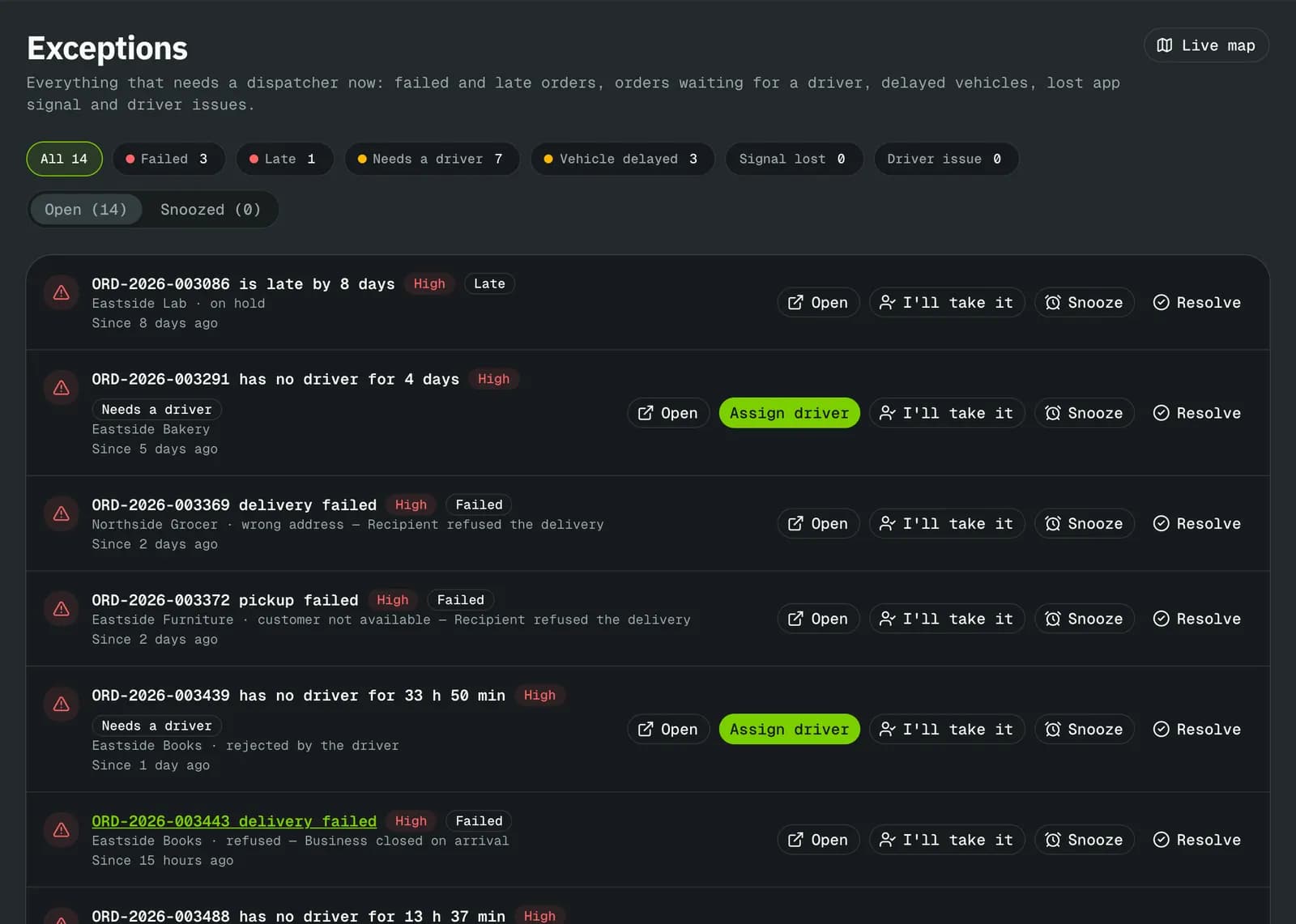
Watch the delays in real time, too. A live map that shows each vehicle's next stop and how late it is running lets you move the last stops of a struggling route to another driver before they become failures.
2. Promise less, deliver what you promise
Your delivery promises should change with the season:
- Stretch service levels on storm days. If "same day by 5 pm" is unrealistic, say "same day, best effort" or move cut-off times earlier.
- Close on the right days. A business calendar with the federal and provincial statutory holidays avoids "next day" promises landing on Boxing Day or Family Day.
- Price the season honestly. If winter costs you more, a clearly named seasonal or dated surcharge is easier to defend than raising base rates quietly. Tell customers in advance.
3. Rethink safe drops
A parcel left at the door in July is fine. The same parcel in a snowstorm can be soaked, frozen or buried. Review your safe-drop rules for winter:
- Do not leave temperature-sensitive goods outside. Medication, food, plants, paint, electronics and anything liquid can be damaged by freezing.
- Require a photo for every safe drop, showing where it was left and that it is sheltered.
- Prefer a neighbour, a reception desk or a locker to a porch.
- Use "can't access" honestly. An unshovelled path or an icy staircase is a safety reason, not a driver failing.
Proof matters more in winter because disputes rise. Our post on proof of delivery that settles disputes explains how to set rules per customer and address.
4. Keep drivers safe
Driver safety is the part of winter planning that cannot be improvised.
- Tires. Québec requires winter tires on passenger vehicles from 1 December to 15 March, and British Columbia requires winter tires or chains on many highways from 1 October to 31 March (to 30 April on some routes). Even where they are not required, winter tires are standard practice. Check the current rules for each province you drive in.
- Vehicle checks at clock-in. A short checklist: tires, wipers and fluid, lights, a scraper and brush, a shovel, a blanket, a phone charger.
- Give drivers permission to stop. Make it clear, in writing, that a driver who decides a road or an address is unsafe will not be penalised. Give them a failure reason for it.
- Breaks to warm up. Cold, repeated in-and-out of a vehicle is tiring. Plan breaks, and track them.
- Check in. On the worst days, dispatch should know where every driver is and hear from them regularly.
Footwear and traction aids for walking from the van to the door matter as much as the van's tires: most winter injuries in delivery work happen on foot.
5. Look after the phones
Cold drains phone batteries fast, and signal disappears in the same places it always does: underground parking, rural roads, steel buildings.
- Keep phones warm and charged: a car charger in every vehicle, and a power bank for long routes.
- Make sure the driver app keeps working without signal, queuing proof photos and status updates until the connection returns.
- Check the location and battery settings on drivers' phones before the season starts.
6. Tell customers before they ask
On a storm day, the phone rings constantly with "is my delivery still coming?". The fix is to send the answer first.
- Morning message on storm days. A short email or text to affected customers: "Snow is slowing deliveries today. Your order is still scheduled; we will send your tracking link when it is on its way."
- Tracking links on every order, so recipients can check without calling.
- Honest failure messages. If a delivery fails because the address was not safe to reach, say so, and offer the next attempt.
- Quiet hours. Delays often push updates into the evening. Hold non-urgent texts overnight.
7. Have a storm-day playbook
Write one page that dispatch can follow, covering:
- Who decides to switch to storm mode, and when.
- Which customers and services are prioritised.
- The message templates to send.
- How routes are cut back and which orders move to tomorrow.
- How failed and held orders are reviewed at the end of the day.
How NemiRoute helps in winter
NemiRoute does not predict the weather, but it makes a storm day easier to run. The live map shows each vehicle's next stop, ETA and delay, and a dispatcher can hand a route's remaining stops to another driver. The business calendar includes Canadian federal and provincial statutory holidays, and time-based surcharges cover after-hours, weekend, holiday and dated peak periods. Proof rules can forbid safe drops for a customer or service, and a safe drop always needs a photo. Drivers clock in with a vehicle checklist and odometer reading, report failures with reasons such as "Unsafe location" or "Access denied", and the driver app keeps working offline. Email and text templates can be edited per event, with SMS quiet hours.
Drivers can read Work without signal and Location and battery settings before the season starts.
Next step
Before the first storm, write your playbook and set your rules once. Start free or book a demo. For the deliveries that fail anyway, read Ten ways to cut failed deliveries.
- winter
- operations
- safety
- canada
- customer communication