Cash on delivery done right: reconciling driver cash every day
A practical routine for collecting, handing in and reconciling cash on delivery, so shortfalls are found the same day and nobody argues about money at the end of the month.
5 min read
Cash on delivery is still common in courier work: furniture and appliance deliveries, auto parts to small garages, restaurants paying for supplies, and customers who simply prefer to pay at the door. It is also where small amounts of money quietly go missing, not usually through dishonesty, but through change given wrongly, a customer who was short "just this once", or an envelope that sat in a glovebox for a week.
The takeaway: treat COD cash like inventory. Every dollar is either with a driver, handed in, or explained, and you should be able to say which on any given day.
The three numbers that matter
For every COD order, there are three amounts:
- Due: what the customer should pay.
- Collected: what the driver actually received.
- Remitted: what the driver handed in to the office.
Most COD problems come from mixing these up. If a customer paid $5 short, the driver did nothing wrong, and the gap is a customer receivable, not a driver shortfall. If the driver collected the full amount but handed in $5 less, that is a driver shortfall. Recording both differences separately is the single most useful thing you can do.
A daily routine that works
Before the route
- Put the amount due on the order, not on a sticky note. The driver app should show it at the stop.
- Decide the payment rules: exact cash only, or change allowed? Cheques? Card at the door? Write them down for drivers and customers.
- Give drivers a float if they need to make change, and record it.
At the door
- The driver records the amount collected as part of completing the stop, before leaving.
- If the customer pays less, the driver records what was paid and why ("customer short", "refused part of the goods"). They should not cover the gap from their own pocket.
- The receipt goes to the customer: a tax receipt where you charge tax, or at least a clear record of the amount paid.
At the end of the day
- The driver hands in the cash and the office counts it against the system's expected total.
- The office records the amount received. If it does not match, note the difference and the reason on the spot, while the driver is still there.
- Both sign a handover slip. It sounds old-fashioned, and it prevents most later arguments.
Within the week
- Any cash still with drivers past your limit (for example two days) gets a reminder, to the driver and the office.
- Every open difference is resolved: written off, billed to the customer, or deducted from the driver's pay where that is lawful and agreed in writing.
Handling the awkward cases
The customer was short. Do not treat this as the driver's loss. Decide whether to bill the remaining amount to the customer on an invoice, write it off, or record that nothing more was owed (for example, the customer refused part of the order).
The driver is short. Talk to the driver first. Most shortfalls are counting mistakes or change given wrongly. Agree whether the amount is written off or deducted from pay, and record the decision with a note. Note that deducting from wages is regulated by provincial employment standards: an employer usually needs the employee's written authorization, and some deductions are not allowed at all. Check the rules for your province before you make deductions a policy.
The driver disputes the count. Mark the collection as disputed, recount with both people present, and keep the note. If the cash turns up, it goes back to "with the driver" until handed in.
Cash sits with a driver for days. This is the most common problem, and the most fixable. Daily reminders and a visible "oldest cash" age per driver fix most of it.
Tax receipts and COD
If you charge GST/HST (and QST in Québec) on deliveries, the customer paying cash still needs a receipt showing the tax. The delivery fee and the goods are not the same thing: if you collect the price of goods on behalf of a merchant, that money is the merchant's, and the tax on the goods is their matter, while your delivery fee is yours. Keep the two amounts separate on the order. Our post on GST, HST, QST and PST for courier companies explains the delivery side.
Reports your accountant will want
At the end of each month you should be able to produce, in a few minutes:
- Total COD due, collected and remitted.
- Open differences by driver and by customer.
- Write-offs and deductions with their reasons.
- Every remittance with its date and handover slip.
If that takes a day of spreadsheet work, your COD process is costing more than the shortfalls themselves.
How NemiRoute handles COD
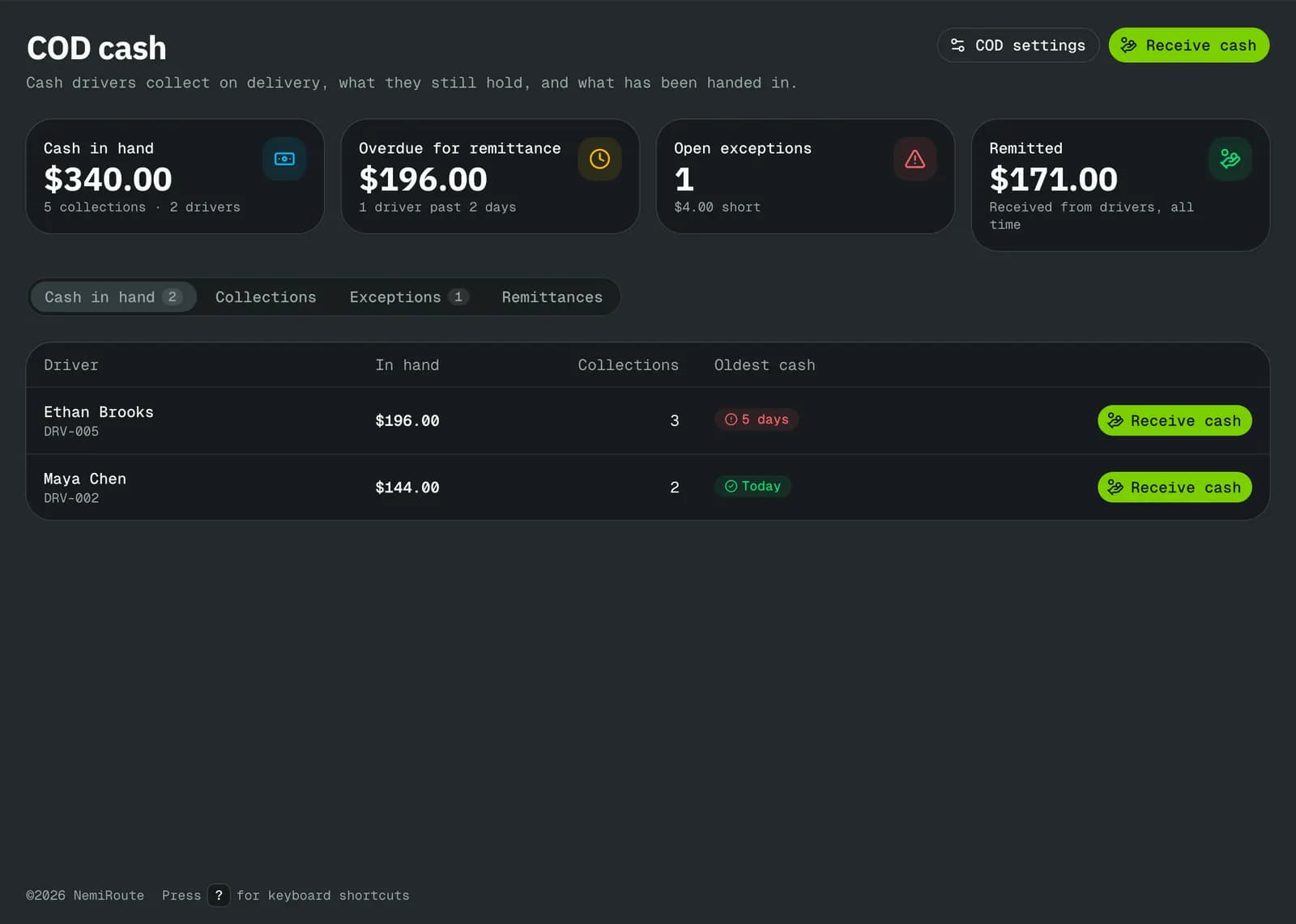
In NemiRoute, cash on delivery is part of the billing and payments side. The amount to collect arrives with the order when the customer books in the portal, uploads a spreadsheet or uses the API. The driver app records the cash collected as part of the proof checklist. The COD cash page shows who holds how much, how old the oldest cash is, what is overdue for remittance and which exceptions are open. When a driver hands in cash, the office ticks the collections being handed in, enters the amount received, and records the reason for any difference; a handover slip with signature lines can be printed. Shortfalls appear as exceptions to resolve by writing them off or, when you turn that setting on, deducting them from the driver's open pay period. When a receiver paid less than due, the difference is kept apart from the driver: you can write it off or record that nothing more was owed. The cash collected is treated as the shipper's money: it is credited to their account when it is handed in, and the delivery fee stays on their invoice with its tax. Daily reminders go out for cash older than the number of days you set.
COD totals also show on the operations overview, so dispatch and finance see the same number. Pay deductions flow into driver pay statements, which is worth reading if you pay a mix of employees and contractors.
Next step
Tonight, ask each driver how much COD cash they are holding and compare it with your records. If you cannot answer in under a minute, start free or book a demo to see the COD page on the demo company.
- cash on delivery
- cod
- finance
- drivers