A lot of courier companies in Canada have no depot at all. A driver picks up an envelope at a law office on Bay Street and drops it at the courthouse. A van collects a part from a distributor in Laval and takes it straight to a garage in Longueuil. A car picks up a lab sample in Surrey and delivers it to the lab in Burnaby. Nothing is sorted, nothing is stored, and the whole job takes an hour.
Point-to-point work has different economics from depot-based delivery. The takeaway: without a depot, your capacity is your drivers' time, so everything (pricing, dispatch and pay) should be built around minutes, not parcels.
How point-to-point work is different
In a depot operation, you consolidate: parcels come in, get sorted onto routes, and a van delivers thirty or eighty stops in a loop. Efficiency comes from density.
In point-to-point work, each job is its own trip. The driver goes from wherever they are to the pickup, then to the delivery, then to the next pickup. Efficiency comes from:
- Short empty legs between one drop and the next pickup.
- Fast assignment, so the closest available driver takes the job.
- Clear service levels, so you are not promising a 60-minute delivery on a job that needs two hours.
- Batching where you can, such as several envelopes from the same office to the same area.
Dispatching without a depot
Without a depot, the dispatcher is matching jobs to drivers in real time. What helps:
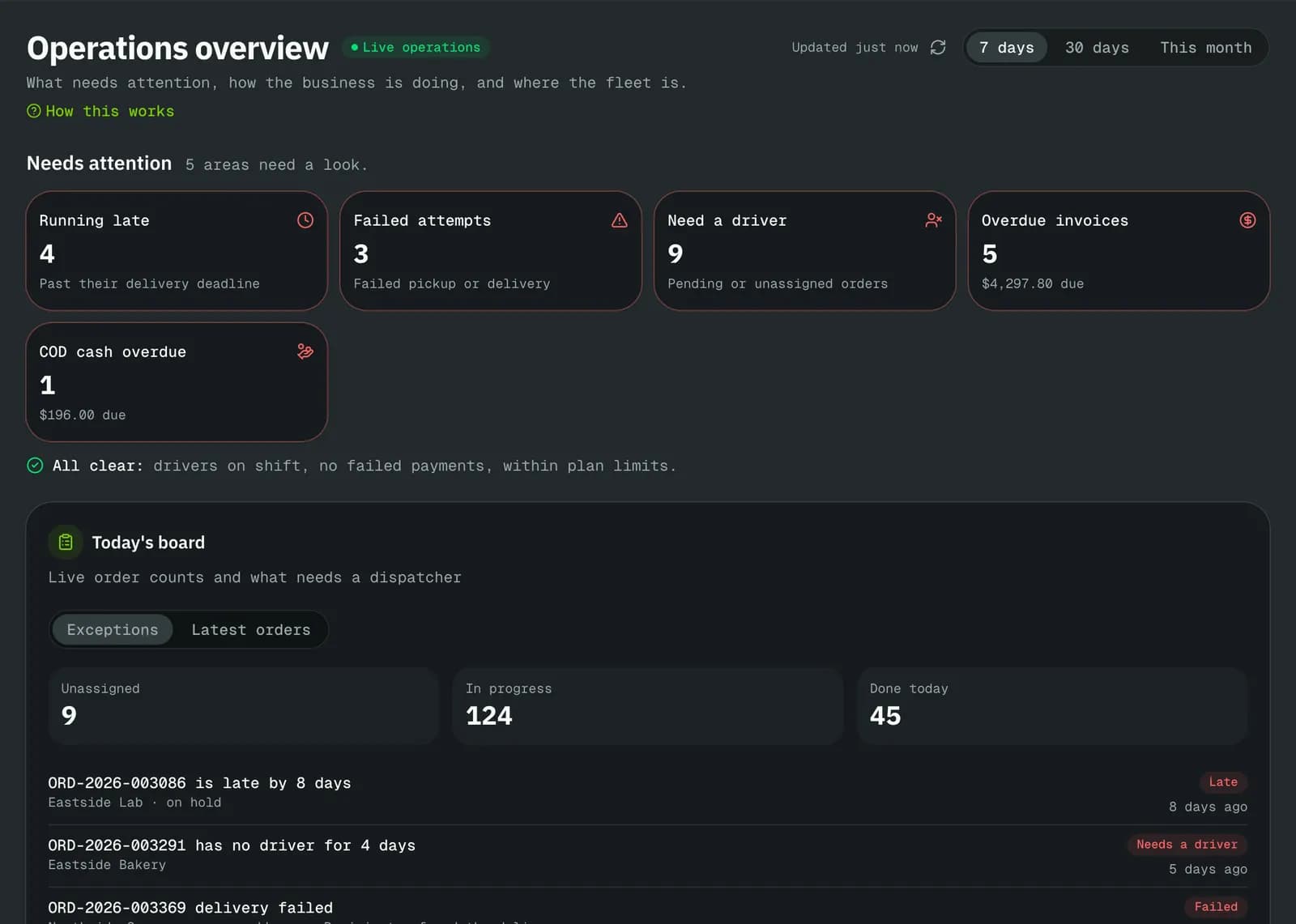
- See where everyone is. A live map with each driver's current job and next stop is the main screen. The question is always "who will be free closest to this pickup, soonest?"
- Assign in one action and let the driver's phone tell them. Calling each driver to read out an address does not scale past a handful of jobs an hour.
- Let customers book themselves. A portal or an API means jobs arrive with complete addresses, contact names and a price, instead of a voicemail.
- Use multi-stop jobs for regular runs. A daily run that collects from six clinics and delivers to one lab is one job with seven stops, not seven separate orders. The same applies to "deliver and bring back the signed papers": a return leg on the same job.
- Watch the clock, not the parcel count. The useful warnings are "this job will miss its deadline" and "this driver has been at the pickup for twenty minutes".
Pricing point-to-point jobs
Because your cost is driver time, your price should reflect the time a job takes, including the parts the customer does not see.
- Zones or distance for the core price. A zone table works well inside a city; distance works better for longer runs. Many couriers combine them. See Zone pricing explained.
- Service levels as separate products. Direct (go now), rush (within the hour), same day (by end of day). Each is its own price, because each uses a driver differently.
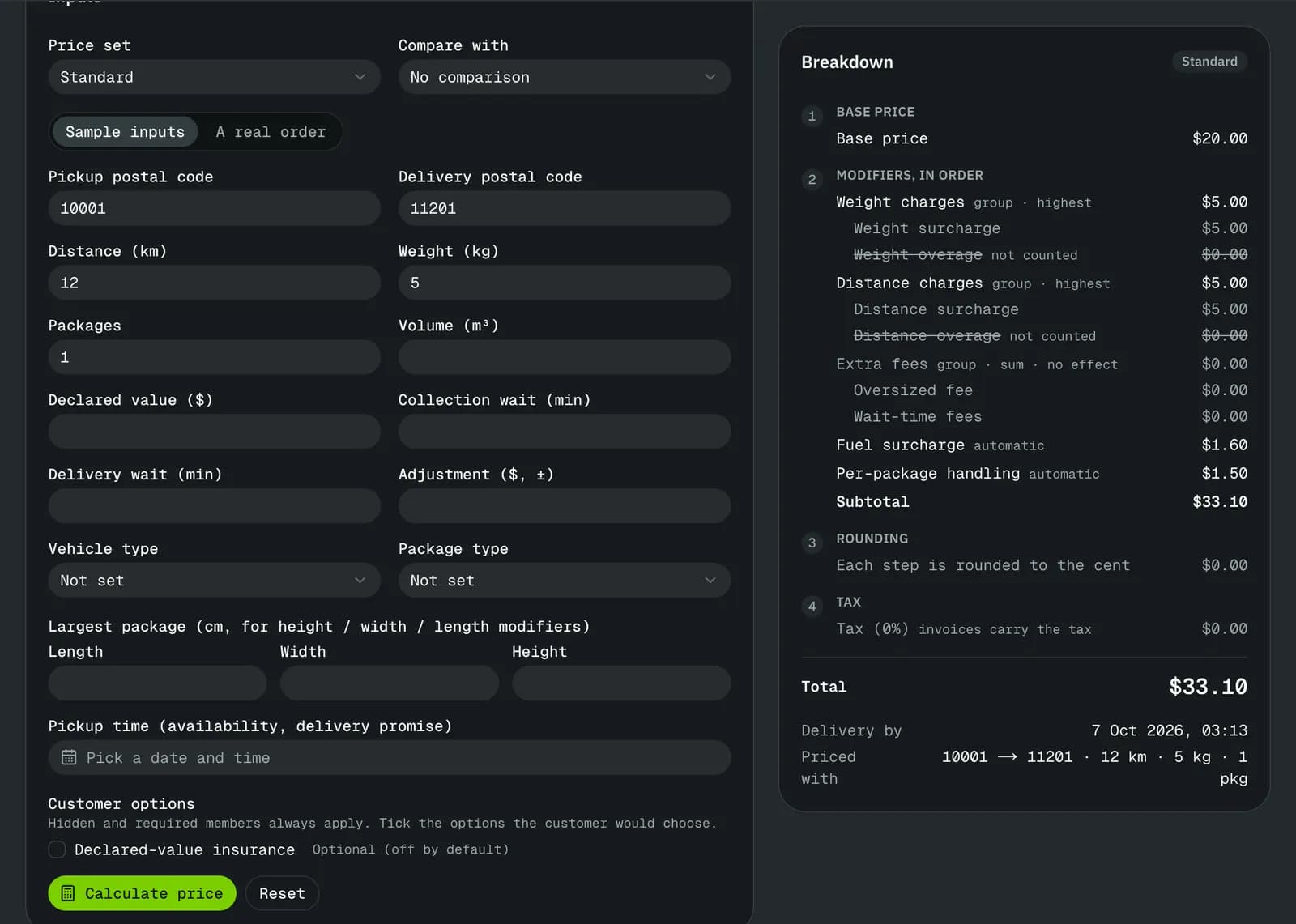
- Waiting time. A driver waiting twenty minutes at a reception desk is twenty minutes not driving. Charge for waiting beyond a free allowance, based on the actual arrival and departure times.
- Extra stops and return trips. Price them explicitly: a rate per extra stop and a return-trip charge are easier to explain than a higher base.
- Minimum charge. A three-block hop costs you nearly as much driver time as a ten-kilometre run once you count getting there. A minimum charge per job protects you.
Our post on how to price B2B same-day delivery in the GTA, Vancouver and Montréal works through the method in detail.
Paying drivers for point-to-point work
Point-to-point couriers often pay drivers per job or a percentage of the job price, especially when drivers use their own vehicles. A few principles:
- Pay should follow effort. If you charge customers for waiting time and extra stops, consider passing part of those charges to the driver. Otherwise drivers learn to avoid the jobs that pay you more.
- Own-vehicle drivers carry costs. Fuel, insurance and wear come out of their pocket. A per-kilometre or daily vehicle allowance on top of job pay is common.
- Failed and cancelled jobs. A driver who drove to a pickup that was cancelled at the door has lost time. Decide what you pay for that and write it down.
- Know the status of each driver. Employees and independent contractors are treated differently by the CRA and provincial employment rules. Read Employees vs contractor drivers in Canada before you set this up.
Proof without a depot scan
Depot operations get a natural checkpoint: the parcel is scanned at the dock. Point-to-point work has only two moments of custody, the pickup and the delivery. That makes proof at both ends more important:
- A signature and printed name at pickup settles "your driver never collected it".
- A signature, name or photo at delivery settles "it never arrived".
- A location stamp on each settles "the driver was not there".
See Proof of delivery that settles disputes for how to set rules per customer.
When to add a depot
Many point-to-point couriers eventually add a small depot, usually for one of three reasons: a customer wants next-day delivery of many parcels, a regular inbound shipment needs to be broken down, or out-of-town work needs a cross-dock. You do not need to plan for it now, but choose software that handles both, so you do not have to switch systems the day you sign a lease.
The traps to avoid
- Pricing by distance alone in dense downtown cores, where time matters more than kilometres.
- Not charging for waiting, then wondering why margins vanish on certain customers.
- One dispatcher's memory as the system. If only one person knows which driver is where, you have a single point of failure.
- Over-promising rush service at the end of the day, when every driver is on the far side of town.
- No minimum charge, which makes the shortest jobs the least profitable.
How NemiRoute handles direct jobs
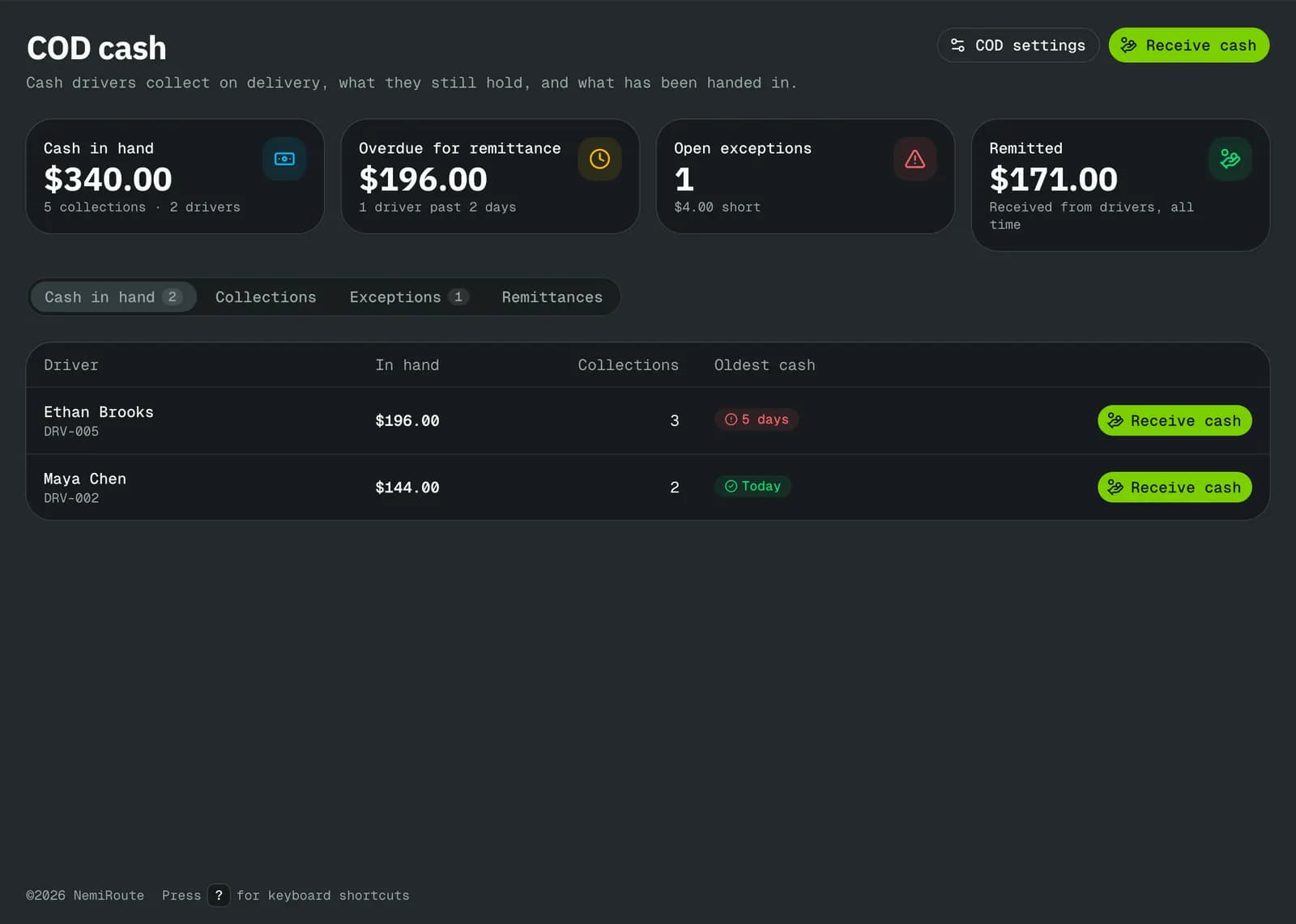
NemiRoute handles point-to-point work directly. An order can be a direct job with no depot: the pickup is an address from the customer's address book, and the job goes straight to the delivery. Direct jobs are given to one driver (by hand or by auto-assign) rather than planned onto routes, which always leave from a depot. You don't create a depot record: drivers and vehicles can have no home depot, and portal orders collect at the customer's own pickup address. Multi-stop jobs hold an ordered list of stops with an optional return leg, and recurring jobs cover standing runs such as a daily lab collection. The pricing engine has modifiers for waiting time, extra stops, return trips, rush and a minimum charge, and the live map shows each driver's next stop, ETA and delay. Driver pay plans can pay per delivery, per kilometre, per stop or a percentage of the order, with different rates for company and own vehicles and a vehicle allowance. Same-day operators should also look at how this fits a same-day courier's day.
One thing not to plan on in Canada: the independent driver network for overflow work is a pilot that only runs where the platform has opened a market, today the New York area.
Next step
List your last week's jobs with the time each one took, door to door, including waiting. Compare that with what you charged. Then start free and set up one service as a price set, or book a demo.
- same-day
- point-to-point
- operations
- drivers
- pricing